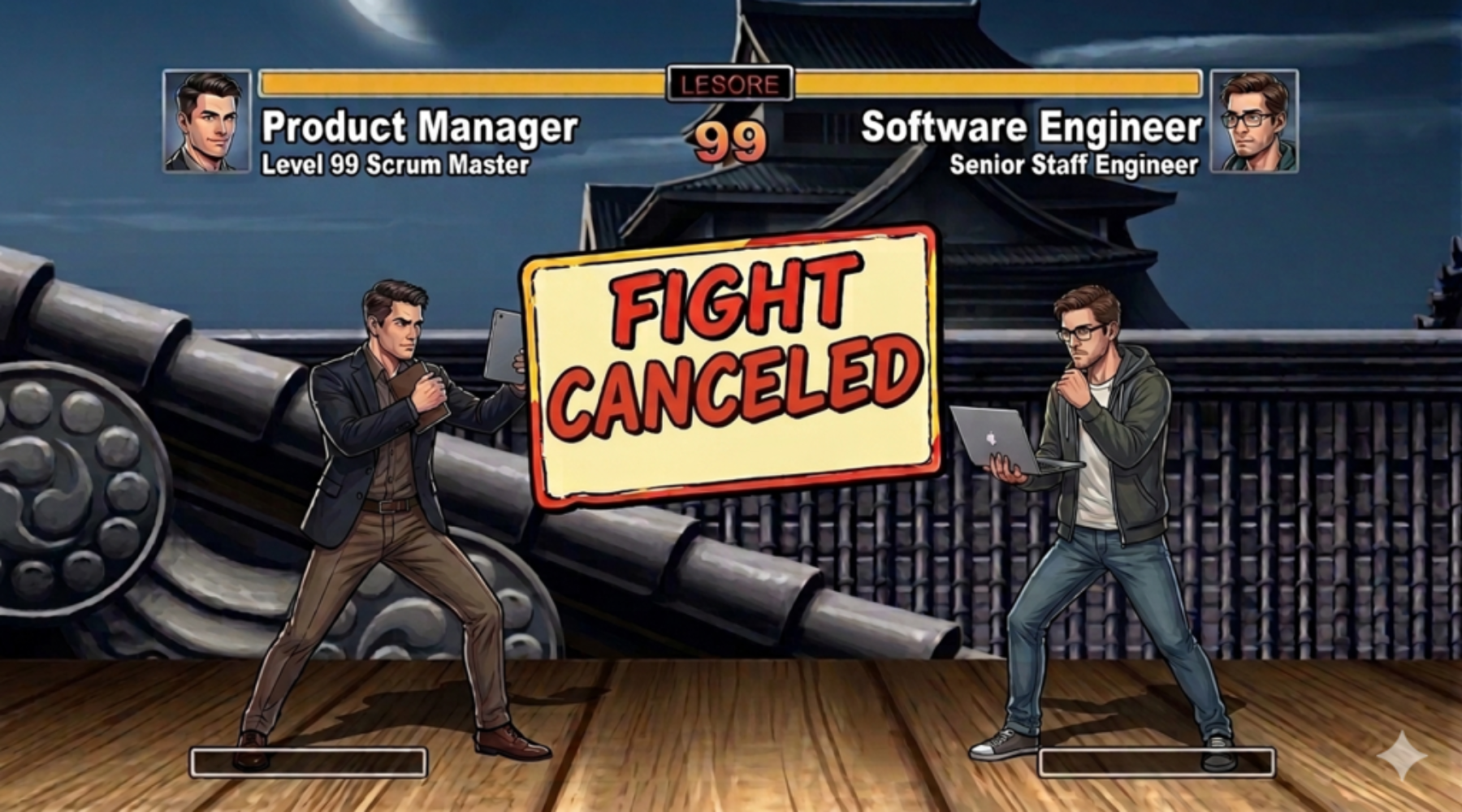
PM vs Engineer. Fight Canceled.
For years, the product manager vs engineer debate had a clean and comfortable story.
Product managers decided what to build. Engineers built it. Designers made it look good. Simple, neat, and, as it turns out, wrong.
That structure worked when building software was slow and expensive. Today, however, AI writes code, generates UI, and spins up prototypes in hours. So naturally, people started asking: will product managers replace engineers, or will engineers replace product managers?
Nice drama. Wrong question. Let’s break it down.
What AI Actually Changed for Product Managers
PMs used to live in docs, meetings, and roadmaps. Traditionally, they defined problems and handed solutions to engineers.
Now, though, AI gives them new power. A PM can build a working prototype in a weekend, test ideas without waiting weeks, and show instead of tell. As a result, behavior changes fast. Less talking. More doing.
But here is the catch.
A prototype is a toy until it survives real users. Scaling systems, handling edge cases, and securing data still require deep engineering skill. AI helps enormously, but it does not replace the judgment built over years of hands-on work.
So PMs move closer to building. They do not, however, take over.
What AI Actually Changed for Engineers
Engineers used to focus on code quality, performance, and systems architecture. Historically, many stayed far from users and product decisions.
That distance is shrinking fast. The best engineers today join user calls, push back on weak product ideas, and measure impact rather than tickets closed. In other words, they think in terms of value, not tasks.
But here is the catch on this side too.
Understanding users at scale is genuinely hard. Patterns, trade-offs, and priorities across teams take structure and time to develop. Consequently, engineers move closer to product thinking. They do not, however, take over either.
The Product Manager vs Engineer Collision
What is happening is not a takeover. It is a collision.
Both roles are moving toward each other, and as a result, new types of builders are emerging. You start seeing PMs who ship real features and engineers who shape product direction. These people move faster, cut handoffs, and learn from users much more quickly. Companies love this, understandably.
At the same time, though, something else is happening.
Depth is becoming rare. When everyone can do a bit of everything, true expertise stands out more than ever. A strong engineer designs systems that last, handles scale before it breaks, and makes complex trade-offs look simple. A strong PM, on the other hand, finds the right problem, confidently says no to the wrong ones, and aligns people around clear outcomes.
AI does not erase these skills. Instead, it exposes who actually has them.
So Who Wins the PM vs Engineer Debate?
No one, because the game itself changed.
The real shift is from roles to capabilities, from ownership to outcomes, and from process to speed. The tension you feel between these two worlds is actually useful, because it forces important questions. What is your edge? What do you go deep on? What do you learn next?
The future is not product manager versus engineer. Rather, it belongs to people who understand users deeply, build or shape solutions directly, and think in terms of systems and results.
The Line Moves. Keep Moving With It.
The line between PM and engineer does not disappear. It moves, constantly, and your job is to move with it.
So here is a better question to sit with. If both roles keep moving toward each other, what do you become in the middle? And what will you master that others are still too comfortable to touch?