Your Roadmap Is Not a Plan. It Is a Comfort Blanket.
I stopped building roadmaps about a year ago.
Not because I got lazy. Because I kept watching the same thing happen across every company I consulted for.
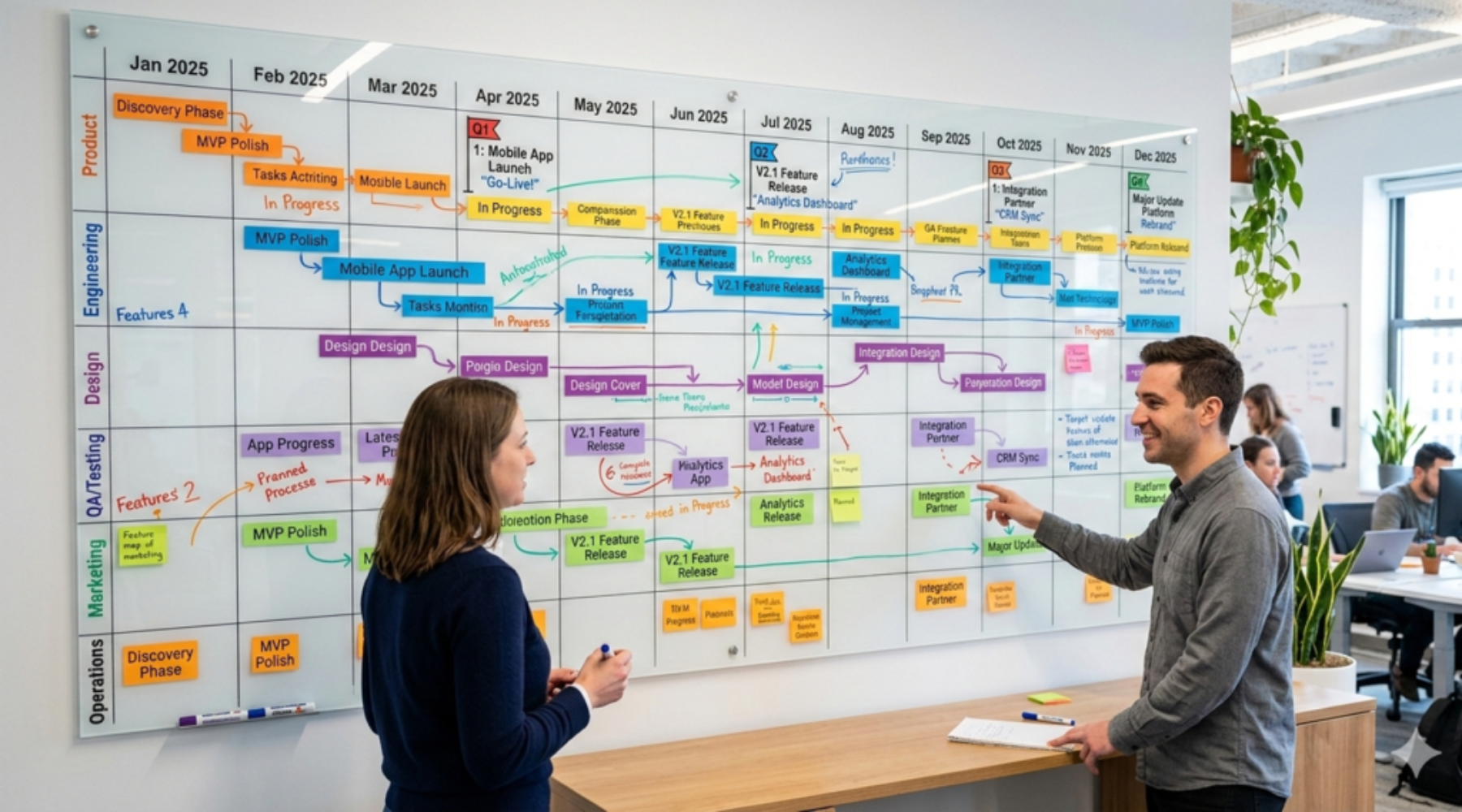
We would spend weeks building the roadmap. Color-coded. Quarterly. Beautiful. The kind of thing you print, hang on the wall, and feel genuinely proud of.
Then reality would show up. Unannounced. Usually on a Tuesday.
A competitor ships something unexpected. A key engineer leaves. Users start behaving in ways nobody predicted. And suddenly that gorgeous 12-month roadmap is just a very expensive piece of fiction hanging on the wall.
The moment that really got me was at a real estate software company I joined as a consultant. They had a roadmap. They had sprints. They had ceremonies for their ceremonies. They also had a product that was quietly losing relevance while the team was busy executing a plan nobody had pressure-tested with real users.
I asked a simple question in one of my first sessions. “When did you last sit down with an agent who uses this platform every day?”
Silence. Not the “we’re thinking” kind. The “oh no” kind.
The roadmap had become the product. The team was shipping features to satisfy a document, not a real estate agent trying to close deals. And nobody had noticed because everyone was too busy being busy.
Here is what I have come to understand after eighteen months of seeing this pattern repeat itself. A 12-month roadmap is a bet on a future you cannot see, written with confidence you should not have, committed to a timeline that will definitely change. And then everyone acts surprised when it does.
The best teams I have worked with lately do not operate this way anymore. They run short cycles. Six weeks maximum. One clear hypothesis. One measurable signal that tells them whether they were right. If they were wrong, they learn fast and adjust. If they were right, they double down. No drama. No wasted quarters.
I came across an article recently that stopped me mid-scroll. It talked about how companies like Slack have stopped committing to big fixed roadmaps entirely. They now run tiny cross-functional squads, sometimes just one designer and one engineer, using AI to prototype fast and get feedback faster. The piece called the traditional 12-month plan a liability, not a plan. After what I have seen in the field over the past year and a half, I think that description is actually generous.
Dropping the fixed roadmap costs something real. You lose the illusion of certainty. Stakeholders who need a 12-month plan to sleep at night will push back. Some will not let go easily.
But here is what you gain. Shorter cycles force real conversations with real users more often. Explicit hypotheses force the team to agree on what success looks like before they build anything. And teams move faster. Not because they are rushing. Because they are not dragging the weight of a plan that stopped being relevant three months ago.
The thing I learned, and genuinely did not expect, is that the roadmap was never really about the product. It was about managing anxiety. Leadership anxiety. Stakeholder anxiety. Sometimes PM anxiety too.
Once I understood that, the conversation changed completely. The goal was not to kill the roadmap. It was to replace the anxiety with something more honest. A clear problem to solve. A short bet on how to solve it. A real signal to know if we were right.
That is a plan worth building.